
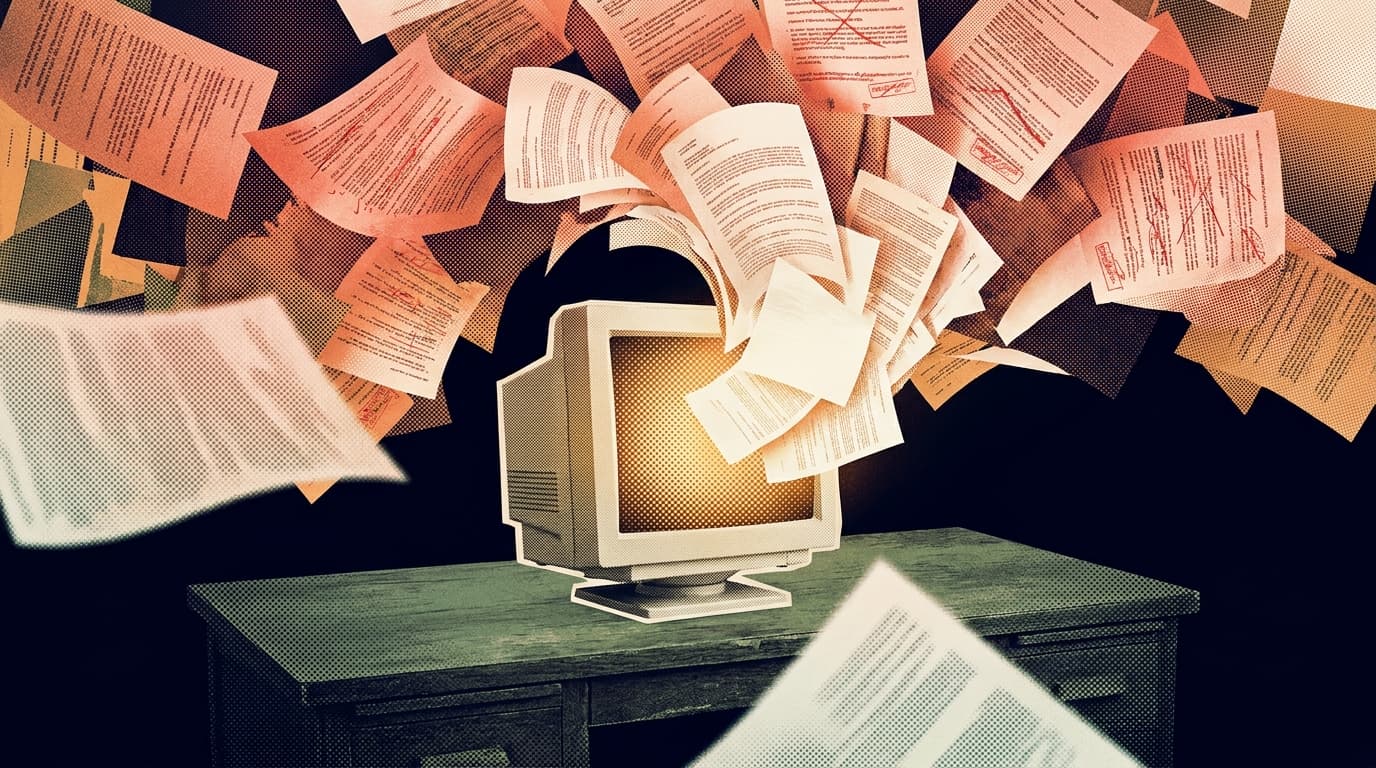
AI was supposed to save time at work. Stanford researchers have a word for what it's actually producing: "workslop."
The term, coined by a team of researchers including Jeff Hancock, describes the flood of low-quality AI-generated content that workers are now expected to review, fix and redo. Companies mandate the tools, celebrate the efficiency gains, then leave employees to clean up the output.
The most rigorous evidence that those gains aren't real comes from Denmark. A study published by the National Bureau of Economic Research linked AI adoption surveys to actual government payroll records and found essentially zero impact on earnings or hours worked. This wasn't a vibes-based survey. Researchers used administrative data precise enough to detect a 2% shift. They found nothing.
Workers in AI-exposed roles are adopting the tools and say they feel more productive. But those feelings aren't showing up in the economic data. "Technological change reshapes work well before it surfaces in earnings or hours," the researchers wrote. The work is changing shape. The paychecks are not.
New research from Workday shows where the time actually goes:
- 85% of employees report saving one to seven hours a week with AI
- Nearly 40% of that saved time gets lost to fixing low-quality AI output
- 32% of companies respond to efficiency gains by simply increasing workloads
AI gives you an hour. Rework takes back 24 minutes. Your employer takes the rest.
A copywriter at a Miami cybersecurity firm described what happened after his company rolled out mandatory AI tools. "Quality decreased significantly, time to produce a piece of content increased significantly and, most importantly, morale decreased," he told The Guardian under a pseudonym. "Everything got a whole lot worse."
It's not just office workers. Philip Barrison, a University of Michigan researcher embedded in primary care clinics, told The Guardian that once doctors get past the novelty of AI tools, they tend to just tune them out. And Vivi Mengjie Xiao, a product manager in China who built six AI "employees" using OpenClaw, told Business Insider she's somehow working more than ever: "When your efficiency goes up, you don't work less. You just attempt more."
Aiha Nguyen, who runs the Labor Futures program at Data & Society, points to a structural problem: AI is being sold as a general-purpose tool that can handle anything, but it doesn't work that way. The gap between promise and reality generates its own category of busywork. That pattern might help explain why MIT NANDA researchers found that 95% of enterprise AI initiatives deliver zero measurable P&L impact.

The pitch for AI at work has always been save time, do more. What's actually happening is closer to do the same, plus fix what the machine got wrong. Companies are measuring success by adoption rates, not by whether the work actually gets better. Until that flips, the gap between the executive slide deck and an employee's actual Tuesday is only going to grow. "Workslop" exists because the experience needed a name.